
Harold Hall
Workshop Processes


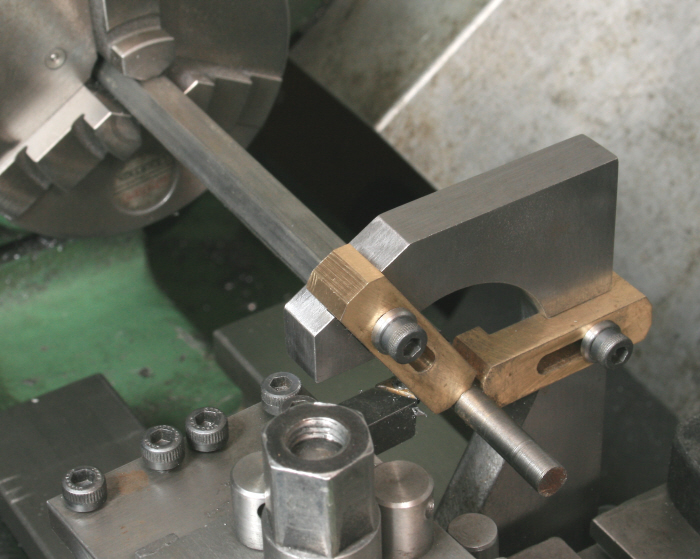
First, the cutter must be set just in advance of the steady's arms, say 4mm, using the top slide and the slide locked in this position. Then, the material for the screw must be held in the chuck with just a small length available and a short length, say 10mm, turned to the diameter required, using the cross slide to set the diameter. The cross slide is then locked and the steady's arms adjusted to the diameter just turned and secured. This must carried out on the actual part being made, rather than a piece of scrap, as the material will need to be supported at the start of the final cut. The material is now moved from the chuck sufficient to make the part fully and with that done, the short length already turned will enable the material to be supported before the cut commences. Photograph 10 shows the cut in progress but also evidence of the transition between the initial short length turned and the final cut, more regarding this later.
Dual Support
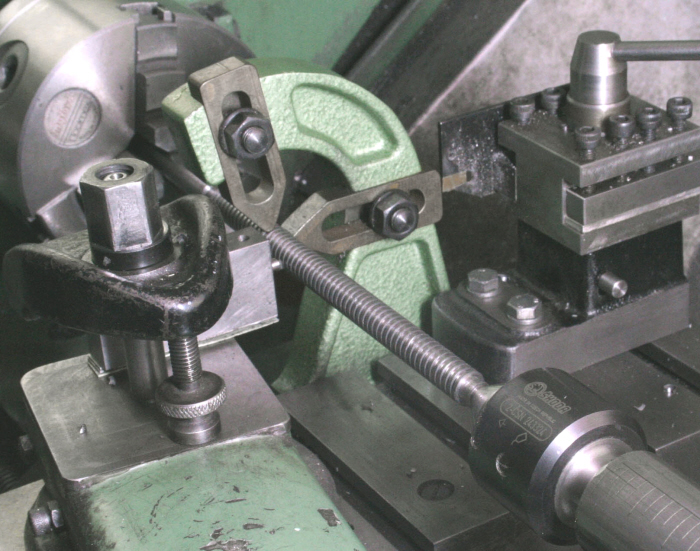
Occasionally, a part will need to be supported by the tailstock as well as the travelling steady, often when a long thread is being cut. For this, the outer diameter can be supported as it will not change as the depth of the thread is increased. Photograph 11 shows a square thread being cut.
A problem of the method is that the first cut will throw up quit sharp burs which will damage the steady's jaws on subsequent traverses. Therefore, after the first cut has been completed the lathe should be set on a higher speed and the burs removed with a wide fine file. Being a square thread, in theory, no burs will be made on subsequent passes but repeating the operation may be worthwhile after a few passes. If a normal thread is being made then the width of the thread will be machined every time the depth is increased. As a result, deburing is best carried out after every pass. In both cases the steady should be in advance of the cutter.
As my three jaw chuck is sufficiently accurate the photograph shows I used this though using the four jaw would have been preferable. In any case the thread stopped well short of the chuck so there was still some flexibility .
Fixed and Travelling steadies. Points to consider
Above, I mentioned that the arms will be worn by the roughness of a square thread being cut, but even with smoother workpieces some wear will occur. In this case, the arms will need adjusting but the method used will depend on the type of workpiece being supported. If long and slender(photograph 2) use just the top arm as whilst this will deflect the part down it will not move it back or forward that may cause a problem if you are turning precision diameters. With short rigid parts that will have minimal flexibility(photograph 8) then all three jaws should be reset.

10

11