
Harold Hall


MAKING THE DIVISIONS
DIVIDING HEAD
Commercially available dividing heads, even from the economy end of the market, are likely to be too expensive for the vast majority of home workshop owners, especially taking into account the limited use it will probably get. For this reason I will illustrate the article largely with two simple dividing heads I have made myself and which features elsewhere on the site.
There are three methods used to achieve the divisions required, with some heads providing more than one method. The methods are, direct, indirect, or differential.
Direct dividing
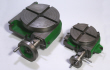
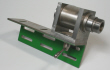
Direct dividing is where a form of division plate, is directly fitted to the head’s spindle, as on the Semi Universal head seen in Photographs 4. Similarly, a gear(not applicable to commercial heads), Photograph 5.
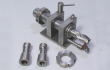
Direct dividing using a single gear in the range 20 to 70 and increments of 5 would appear to give a good range of divisions. It will though only give 2 through to 15 and the full number of teeth on each gear, 20, 25, 30, etc.. One additional feature that can be provided where gears are used is that the plunger can be made as a fork so that it can either locate between adjacent teeth or across a single tooth. This then gives 2 through to 30 then up to 70 by fives and 140 by tens The range can be extended appreciably by using direct mounted dividing plates as in Photograph 6.
Another device that uses direct dividing are Spin indexers, Photograph 7, which have a plate with 36 holes. However, the locating plunger can be placed in one of ten positions working on a vernier principle, Photograph 8. This achieves settings at one degree intervals but still giving only 22 usable divisions though this includes most of the useful low numbers. The indexer seen in the photographs is the Stevenson's Spin Indexer from Arc Euro Trade which can accommodate ER32 size collets as well as the normal 5C collets, a very worthwhile addition. To my knowledge this is not available from any other supplier.
Metalworking
Workshop Processes


4
5
6


7

8