

Harold Hall


Indirect
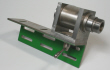
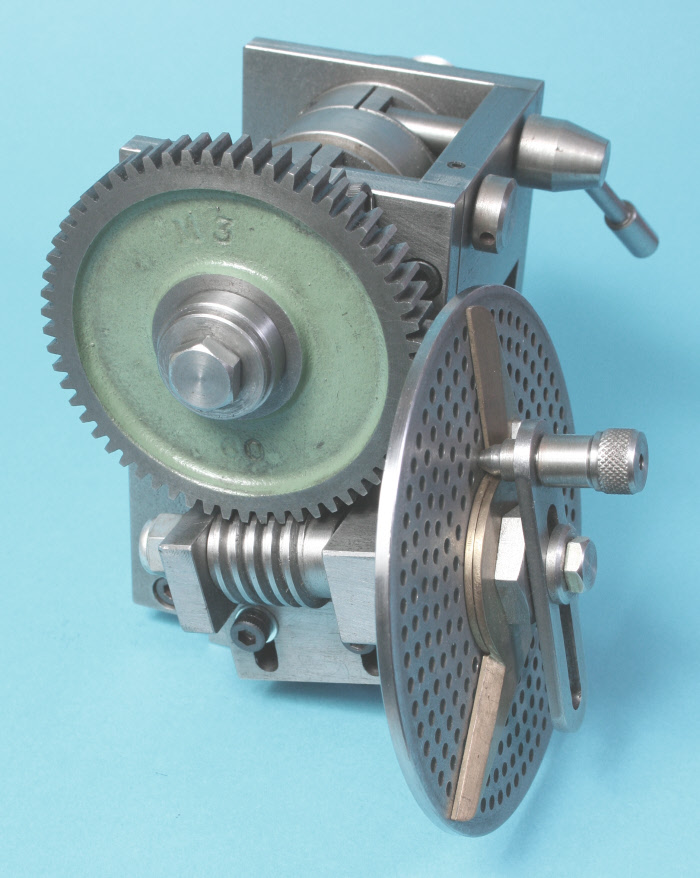
Indirect is where a worm and wormwheel is interposed between the division plate and the dividing head spindle, Photograph 9.
Differential
Differential dividing head are almost entirely a commercial product though I have seen one home workshop made item. In these, the output spindle is driven from the crank handle via the worm and wormwheel in the normal way. However, a gear train from the non working end of the dividing head spindle is arranged to rotate the dividing plate itself by a small amount, as a result, varying slightly the input from the crank handle from the chosen hole to hole value.
By choosing a suitable gear chain, very many divisions can be obtained which are not obtainable by the semi universal head. The mathematics is quite complex and recourse to published figures would be the obvious route, in any case, these should be provided with the dividing head when purchased. These dividing heads are though very expensive!
Worm/wormwheel Ratio
Commercially available indirect dividing heads come with a fixed worm / wormwheel ratio, almost always 40:1. Rotary tables can though be had additionally with ratios of 60:1 and 90:1 However, the setup in photograph 9, using a lathe changewheel, has adjustment for the pitch between the gear and worm permitting the gear to be changed over a range of sizes. This giving a wide range of worm / wormwheel ratios and as a result divisions that are not available using a commercial 40:1 dividing head
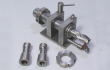
Referring now to Photograph 10, showing an addition pair of gears added to my basic dividing head photograph 2. These two gears amount to a reduction in angular movement between the dividing device, a gear in this case, and the dividing head spindle, in the same way as a worm and wormwheel does. However, the ratio with a worm and wormwheel will always be a simple number 40:1, 60:1, etc.. With two spur gears though the result may be complex. Typically, for example, gears of 55 and 35 teeth will have a ratio 11:7. This will provide additional divisions over those available with a single gear, also some which are not available with a commercial 40:1 fixed ratio head.
Metalworking
Workshop Processes


9

10